
There’s more to Malta than its sandy beaches and clear Mediterranean waters. The archipelago (that’s right: Malta has more than just one island) also has a fascinating linguistic backstory. Let’s take a look at what makes the Maltese language so particular and what it can tell us about the country’s history.
What Language Is Spoken In Malta?
Like with so many places where different cultures collide and mingle, a better question might be: How many — and which — languages are spoken in Malta?
Malta has two official languages: Maltese and English. Until 1934, there was also Italian, but the British (Malta was a British colony at the time) demoted it by way of thwarting the expansionist aims of Italy’s fascist regime, which viewed Malta as a part of its own kingdom. But how did we get here?
To understand which language is spoken in Malta and just how diverse the linguistic landscape is, first we need to take a little trip back in time.
A Brief History Lesson
Between 870 and 1091, Malta was conquered and settled by the Arabs, and the Arabic language quickly took root. In 1091, however, the islands came under Norman rule. From here, things only got trickier.
After the Normans, the islands fell to the Kingdom of Sicily and later to the Crown of Aragon. Administrative and legal communication was conducted in Latin, while communication with the central government in Palermo occurred in Sicilian from the 15th century on. With the settlement of the Knights of St. John, the Tuscan language arrived in Malta. This led to official documents being drawn up in a language that would soon become known as Italian; while ordinary people spoke something we might describe as Maltese-Arabic.
But Malta remained a revolving door for new invaders: after the French Revolution and a (linguistically) non-impactful period of French domination, the British rolled in and turned the linguistic landscape on its head. From 1800, Italian started losing ground to the English language. And in 1814, Malta became a British Crown Colony, with English adopted as the new language of administration. Use of Italian gradually diminished until, as we mentioned above, it was finally stricken from the list of official languages. Meanwhile, the colonizers promoted the standardization of Maltese, leading it to become an official language of Malta in 1964 alongside English. Nonetheless, Italian continues to be spoken by a major part of the Maltese population to this day, and is often chosen as a third language by local students (ahead of German and French).
Malti: The Maltese Language
Maltese is one of Malta’s two official languages, and it’s the only Semitic tongue among the official languages of the European Union. What’s more, it’s the only Semitic language written using the Latin alphabet.
Also known as Malti, Maltese derives from an Arabic dialect that emerged over 1,000 years ago out of Maghrebi Arabic and the Siculo-Arabic spoken in Sicily. Yet centuries of conquest have left their mark, leaving the Maltese language enriched with elements of Sicilian, medieval Latin and English.
The Maltese Alphabet
In its earliest form, Maltese was written using the Arabic alphabet. But for hundreds of years, it remained a purely spoken language, since the official administrative and legal language was Sicilian (as mentioned above). It was only in the 18th century that the first steps were made to introduce some grammatical and orthographic structure to the Maltese language. And in this process, the Latin alphabet was adopted. Its alphabet is made up of 30 letters: in addition to those in the English alphabet, Maltese also has ċ, ġ, għ, ie and ż (it does not have the undotted c or the letter y).
How Many People Speak Maltese?
Maltese is spoken by more than 500,000 people, from the entire population of the country to the diaspora abroad.
A Few Notes On Maltese Grammar
Compared to Romance languages, Maltese has a few distinct grammatical quirks. For example, adjectives always follow the noun and take the definite article; but this rule doesn’t apply to nouns and adjectives of Romance origin.
Like all Semitic languages, verbs in the infinitive have a three-letter root (e.g. “to write”: k-t-b) and are conjugated through the use of prefixes, suffixes and infixes.
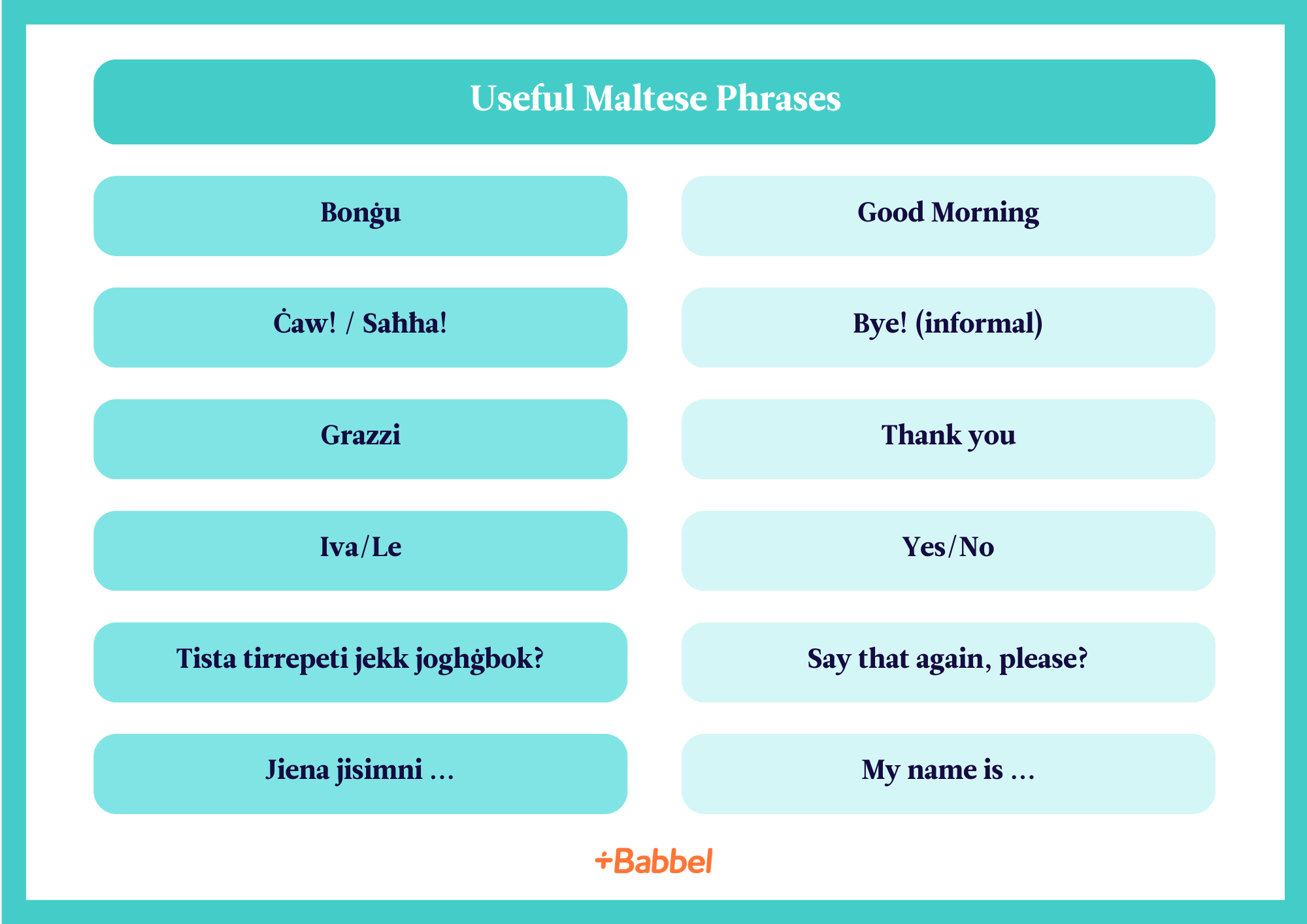
Which Other Languages Are Spoken In Malta?
English
English is the second most commonly spoken language in Malta. Everyone in Malta speaks Maltese, and there are still a fair amount who speak nothing else. But a significant part of the population (88 percent according to recent data) also speaks English, albeit not as their mother tongue. Moreover, English remains an official language, meaning all official documents are drawn up in English as well as Maltese.
A fascinating quirk of Maltese English is its strong Italian influence, both in terms of vocabulary and phonetics.
Italian
Although Italian is no longer an official language, it remains well represented on the islands. According to the latest information, Italian continues to be spoken by almost 300,000 people, a thousand of whom claim it as their first language. This means that the overwhelming majority of Italian speakers in Malta aren’t native speakers.
Despite British efforts to suppress the language, Italian is still going strong. In fact, up until a few years ago, Maltese people mainly watched Italian TV shows, which were the easiest for them to access. And today there are still many organizations and clubs that promote Italian culture in Malta.
Comment