
What do you imagine when you think of Christmas folklore? Is it eight shaggy reindeer dragging Santa on his sleigh through the snow? Or perhaps it’s a row of festive stockings hanging above the mantelpiece?
For many of us, these images are as cliché as they are heart-warming — but some people across Europe have a very different image of the end-of-year festivities. Spaniards, for example, might feel most festive when beating the (literal) crap out of a log, and some kids in Scandinavia won’t be looking out for Santa this Christmas — they’ll be keeping their eyes peeled for a giant goat.
So we’ve dug up some of the weird, wonderful gift givers from around Europe to show you a different side of Christmas folklore this year!
Christmas Folklore Around Europe: The Non-Santa Santa Clauses
1. A Pooping Present Log
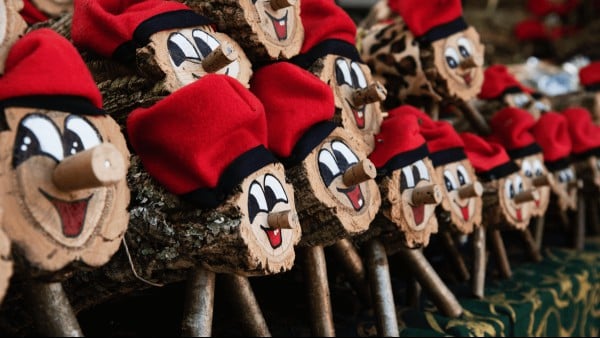
Kids in Catalonia do not get their Christmas presents from a stocking above the mantelpiece — they get them from a Christmas log called Caga Tió, which directly translates to “pooping uncle.” With a cartoonish face painted on one end, these strange logs can be bought at Christmas markets and are kept in the house beginning on December 8, when Catalans celebrate the Feast of the Immaculate Conception.
Once Tió is settled in, children must keep him warm and well-fed, and parents will pop treats into a little hatch on his back every night before he goes to sleep. On Christmas Day, Tió is so full of treats he must relieve himself — and that is when the children beat him with a stick until he poops them all out.
Caga Tió was likely born from the ancient custom of bringing in a large log for Christmas time, which was (and still is) practiced throughout Europe — in some places, this is known as a Yule Log. The log symbolized warmth, nature and the hope for a bright summer. In most places, the log would be burned throughout the Christmas season, with a bit left over to feed the log fire next year. In Catalonia and parts of Aragon, however, this morphed into a log that poops presents.
2. Julebukk And The Christmas Gnomes
In Old Norse, Julebukk translates directly to “Yule goat,” and is as much a part of Christmas folklore in Scandinavia as Santa is in the United Kingdom and United States. The goat is thought to have pulled Thor’s chariot, and later sacrificed its life to provide a feast for Thor and his pals.
In Scandinavian countries, the Julebukk comes in many shapes and sizes. He can be a gigantic goat-shaped figure made of straw with horns so long and curved they touch his hindquarters, or he can be a tiny goat-shaped Christmas decoration. Over time, Julebukk has changed roles to deliver the Christmas gnomes Tomten (Sweden), Nissen (Norway), and Tonttu (Finland) to the doors of children to drop off their presents.
This Yule goat has attained international notoriety in recent years thanks to the Swedish town of Gävle and their gigantic Julebukk statue, which is the victim of annual arson plots! Destroying the giant wicker goat has become a Christmas prank tradition in Gävle dating all the way back to 1956, with the 40-foot sculpture often winding up stolen, smashed to pieces or, usually, burned to the ground.
In recent years, with the world (or, more specifically, the internet) watching, Gävle has gone all-out with their defenses, erecting a double fence, installing 24-hour CCTV and hiring 24 hour guards together with a K9 unit. Here’s hoping the Gävle goat survives another winter.
3. The Italian Christmas Witch
It is Befana, not Santa, who delivers presents to the children of Italy. Her timing is a little different, too. Befana comes a-knocking on January 6, the day of the Epiphany, and she holds the children to high standards. If they’ve been naughty that year, she’ll fill their stocking with coal, and in some parts of Italy they’ll just get a stick.
As the legend goes, when the Magi (the Three Kings) journeyed from far-off lands to bring gifts to the Holy Child, they gathered quite a following from town to town as everyone rushed out of their houses to join this sacred present swap. Everyone except Befana, as the house-proud woman claimed she had too much sweeping to do. The next day she ran after the Magi, gifts clutched in her arms — but they were long gone. Now she is said to fly around on her broom, delivering presents to the world’s children.
Befana probably isn’t as aesthetically pleasing as Santa (often depicted as a hooded old hag), but Italian parents are big fans of the festive sorceress. To say thank you, parents leave a glass of wine out for her on the eve of her arrival. So if you spot an old woman wobbling around on a broomstick in early January, tip your hat to a tipsy Befana.
4. The Yule Lads
Iceland also has their own alternative to Santa. Instead of the jolly old gent jumping down the chimney, 13 imps known as the Yule Lads take turns visiting children over the 13 nights running up to Christmas. Icelandic children leave their shoes by the window, and the Lads will deposit sweets or small gifts inside.
Thirteen days of build-up, unsurprisingly, can lead to considerable over-excitement amongst children — so much so that in 1746, Iceland banned parents from telling stories about the boys!
Each Yule Lad has his own distinct personality, with strange but self-explanatory names such as Door Slammer, Bowl Licker, Door Sniffer and Yogurt Gobbler. Although odd, the Lads are generally thought of as kind fellows, unlike their fiendish counterpart (and mother) Grýla, a grumpy troll who comes down from the mountains at Christmas and boils children alive. Quite an intense bit of Christmas folklore for small children, but there you go.
Comment