
Time for lunch! Your stomach growls, you sit on the edge of your office chair, you want to eat. Actually, you always want to eat because you’re one of those people who is always hungry. You turn to your colleague to ask her if she’d like to take her lunch break with you, but before a sound can come out of your mouth you see a tear rolling down her cheek. Panicked, you look at your lunchbox. Can you ignore the tears? After all, you’re hungry. You can keep quiet and sneak to the kitchen alone. You treasure your colleague’s friendship far too much to leave her all alone… Eating or keeping your friend? It’s a real dilemma.
Suddenly, you’re struck by a flash of inspiration: you can easily have it both ways by asking your colleague what’s wrong, but bring the conversation — very subtly — towards the subject of food, ensuring that you get your lunch break after all. So you finally ask, and discover why your colleague’s crying: her boyfriend broke up with her. You decide to finally tell her, in a nutshell, what you’ve been holding back:
“Look,” you say, “I don’t want to break sugar on your ex-boyfriend’s back (French: casser du sucre sur le dos de quelqu’un, “to say unkind things about someone”), but I can see that you have a lot on your potato (French: en avoir gros sur la patate, “to be sad”), so maybe it will cheer you up if I add my mustard (German: meinen Senf dazugebe, “give you my two cents”).
“Your ex thinks he’s the big cheese, but in reality he only has porridge in his head (Russian: у него каша в голове — u nego kasha v golove, “he’s mixed up”). He has bad milk (Spanish: tiene mala leche, “to have a bad temper”), he’s an unfaithful tomato (German: eine treulose Tomate sein, “to be disloyal”), and was always hanging spaghetti on your ears (Russian: лапшу на уши вешать — lapshu na ushi veshat’ *, ‘to lie’). Furthermore, he looks like a dog sucking a mango (Brazilian Portuguese: *o cão chupando manga, “a very ugly person”).
“To keep it short: He really was not the egg yolk (German: nicht das Gelbe vom Ei, “not the best option”), and the fact that you even liked him shows that you have an artichoke heart (French: avoir un cœur d’artichaut, “to fall in love too easily”). So have a banana (French: avoir la banane, “smile”) and don’t think about him any more!”
Your colleague appears thankful and wipes the tears from her eyes. “You’re right! Thanks for cheering me up. You’re as good as bread (Italian: sei buono come il pane, “to be a good person”). Let’s go to lunch now, our conversation somehow made me very hungry…”
@babbel What’s your favorite idiom in any language? Tell us in the comments! #learnspanish #learningspanish #spanishlearner #spanishlesson #spanishteacher #spanishclass #spanishtips #spanish #latinamerica #spanishgrammar #bilingual #polyglot #multilingual #babbel #language #education #spanishlessons #spanishlife
original sound – Babbel
Still not full? Here are even more idioms about food:
The Best Food Idioms In 13 Languages
English
- That’s the way the cookie crumbles! — (that’s just the way things go)
- Not my cup of tea — (not appealing to me)
- To cut the cheese — (to fart)

German
- Du gehst mir auf den Keks. — You go on my cookie. (You get on my nerves.)
- Die beleidigte Leberwurst sein — to be an offended liver sausage (to be unnecessarily upset)
- Es geht um die Wurst. — It’s about the sausage. (It’s now or never.)
French
- Avoir de la brioche — to have a brioche (to have a little bit of a tummy)
- Être haut comme trois pommes — to be three apples tall (to be “knee-high to a grasshopper”)
- Raconter des salades — to tell some salad (to tell tall tales)
Hindi
- [Bandar kya jaane adrak ka swad?] — What does a monkey know about the taste of ginger? (You’re an idiot, and you don’t know what you’re talking about.)
- Muft ki rotiyan todna — tearing chapatis (Indian flatbread) for free (being a freeloader)
- Kis khel ki mooli hai — Which farm is that radish from? (You’re trying to act smart, but I know you’re a fool.)

Polish
- Żyć jak pączek w maśle — to live like a donut in butter (“to be as happy as a pig in mud”; to be extremely content)
- Masło maślane — buttery butter (the same thing twice over; redundant)
- Rzucać grochem o ścianę — to throw peas at a wall (to do something in vain)
Italian
- Meglio un uovo oggi che una gallina domani — It’s better to have an egg today than a hen tomorrow. (A bird in the hand is worth two in the bush.)
- Se non è zuppa è pan bagnato — If it’s not soup, it’s wet bread. (There is practically no difference)
Japanese
- 逃がした魚は大きい。 (Nigashita sakana wa ookii.) — The escaped fish was the biggest. (Every missed chance seems better than it really was.)
- 花よりだんご。 (hana yori dango) — better dumplings than flowers (practical things are more useful than decoration)
Dutch
- Dat zal me worst wezen. — “That will be sausages to me.” (I couldn’t care less.)
- Ergens geen kaas van gegeten hebben. — “to not have eaten any of the cheese” (to have no idea about something)
Brazilian Portuguese
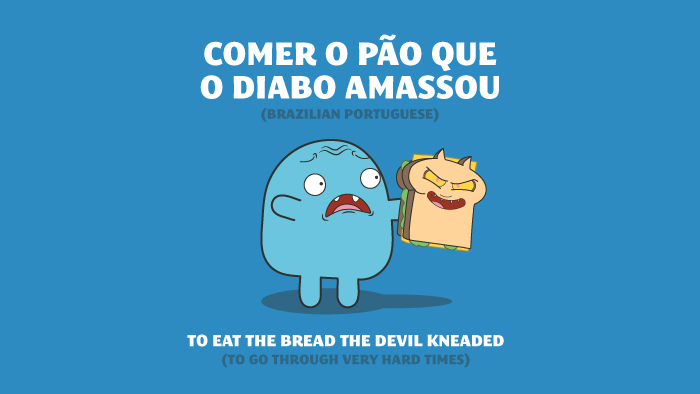
- Comer o pão que o diabo amassou — to eat the bread the devil kneaded (to go through very hard times)
- Se achar o último biscoito no pacote — to feel like the last cookie in the package (to feel very special)
Portuguese
- Afoga-se mais gente em vinho do que em água. — More people drown in wine than water. (alcohol can ruin people’s lives)
- O que não mata engorda. — What doesn’t kill you makes you fatter. (play on words for What doesn’t kill you makes you stronger.)

Spanish
- Para comer pescado hay que mojarse el culo. — To eat fish you need to get your ass wet. (You have to make an effort to get the good things in life.)
- Tocarle los huevos a alguien — to touch someone’s eggs (to anger someone)
Swedish
- Inte för allt smör i Småland! — Not for all the butter in Småland (“not for all the tea in China”; No way!)
- Nu är det kokta fläsket stekt! — Now the boiled bacon is fried! (“my goose is cooked”; I’m in trouble)
- Nu blir det andra bullar! — Now there will be other bread rolls! (“No more Mr. Nice Guy!”)
Turkish
- Armudun iyisini ayılar yer. — The good pears are eaten by bears. (The least deserving people get the rewards.)
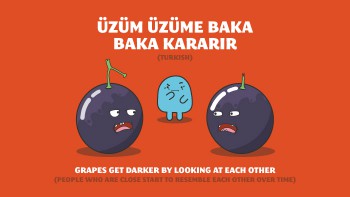
- Üzüm üzüme baka baka kararır. — Grapes get darker by looking at each other. (People who are close start to resemble each other over time.)
Comment