
Some people love a good challenge. We recently gave you the list of easiest languages for English speakers to learn, but maybe you prefer life on hard mode. We checked in with language expert Benjamin Davies from our Didactics team to determine the six hardest languages to learn for English speakers. They may take a bit longer to master, but they’re definitely worth the challenge!
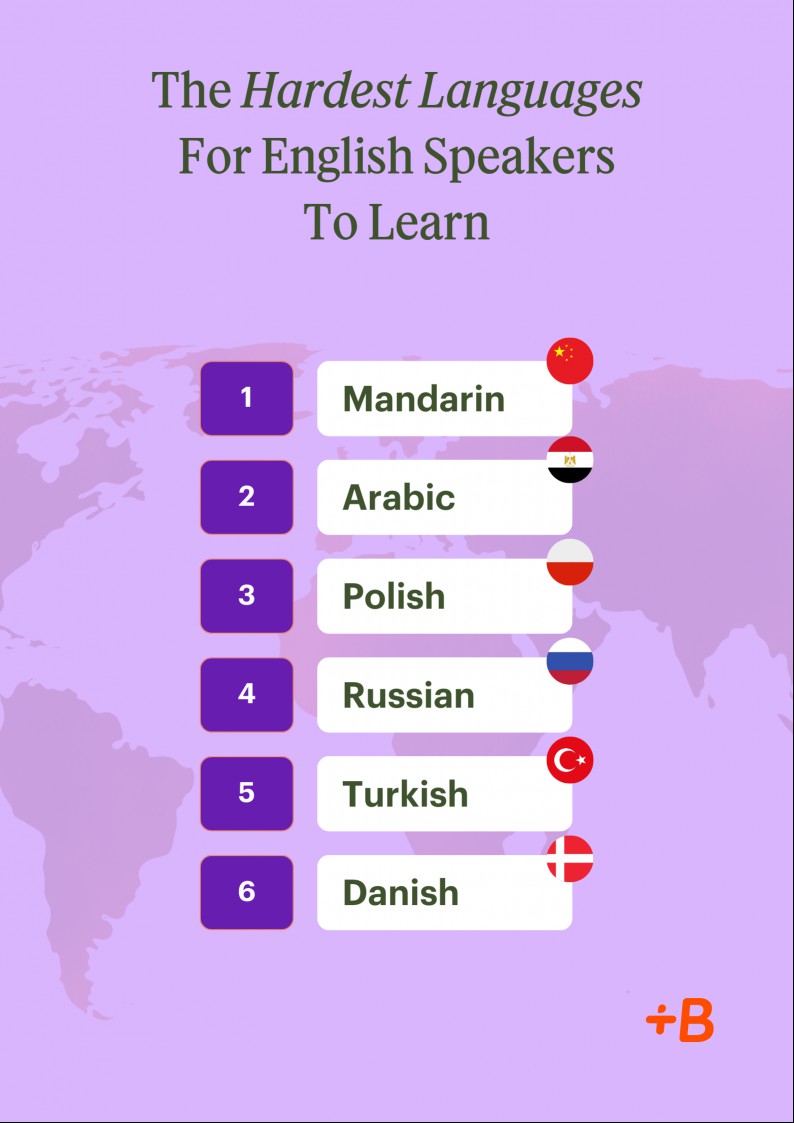
The Hardest Languages To Learn For English Speakers
1. Mandarin Chinese
Interestingly, the hardest language to learn is also the most widely spoken native language in the world. Mandarin Chinese is challenging for a number of reasons. First and foremost, the writing system is extremely difficult for English speakers (and anyone else) accustomed to the Latin alphabet. In addition to the usual challenges that come with learning any language from scratch, people studying Mandarin must also memorize thousands of special characters, unlike anything seen in Latin-based languages.
But writing isn’t the only difficult part of learning Mandarin. The tonal nature of the language makes speaking it very hard as well. There are several Chinese dialects, including Cantonese — spoken primarily in southeastern China, as well as in Hong Kong and other parts of Southeast Asia — which have different written characters and pronunciations, and are also very difficult to learn. Mandarin Chinese (the most common dialect) has four tones, so one word can be pronounced four different ways, and each pronunciation has a different meaning. For instance, the word ma can mean “mother,” “horse,” “rough” or “scold” — depending on how you say it.
2. Arabic
Next on the list of the hardest languages to learn for English speakers is Arabic, which is also in the top five most spoken world languages. For starters, there are dozens of varieties of the Arabic language — generally classified by the region or country in which they’re spoken — that can be radically different from one another. So the first step is to choose which dialect you want to pursue, but that’s the easy part.
Arabic is another language with a non-Latin alphabet. Its 28 script letters are easier for English speakers to comprehend than the thousands of Chinese characters, but it’s still an adjustment to become familiar with a new writing system. The thing that makes reading and writing in Arabic particularly challenging for beginners is the exclusion of most vowels in words. Ths mks rdng th lngg vry dffclt. Arabic is also written from right to left instead of left to right, which takes some getting used to.
There are also characteristics of spoken Arabic that make it hard to learn. Some of the sounds used don’t exist in other languages or are simply unfamiliar to English speakers, including sounds made in the back of your throat. The grammar is challenging too; verbs tend to come before the subject, and you have to learn a dual form of words in addition to the singular and plural forms.
3. Polish
From this point forward, the hardest languages to learn get less difficult but are still quite challenging. Polish got the number three spot on our list.
Spelling and grammar are a couple of areas in which Polish can give English speakers a hard time. Words are loaded with consonants, which makes them difficult to spell and pronounce. For example, szczęście means “happiness” and bezwzględny means “ruthless.” Ruthless, indeed. In terms of grammar, there are seven cases: it’s like German on steroids.
On the bright side, Polish uses a Latin alphabet, so the letters are much more familiar to English speakers than those used in Chinese, Arabic and other non-Latin languages. In addition, being able to speak Polish as a second language puts you in a coveted group, considering Poland’s developing status as a major economy in Europe.
@babbel #creatorsearchinsights Comment which language you think is the hardest to learn for English speakers #hardlanguages #difficultlanguages #languagelearning #hardestlanguagestolearn
original sound – Babbel
4. Russian
Ranking fourth on our list of hardest languages to learn, Russian uses a Cyrillic alphabet — made up of letters both familiar and unfamiliar to us. But speaker beware: some of the Cyrillic letters may look familiar but make a different sound than the Latin letter they resemble. For instance, “B” in the Cyrillic alphabet makes a “V” sound.
Grammatically, Russian is not as difficult as Polish but pretty darn close. Polish has seven cases, while Russian has six. Also, Russians omit the verb “to be” in the present tense, which can throw beginners for a loop when they try to form basic sentences. In Russian, “I am a student” would simply translate to “I student.” Like Polish, Russian uses a lot of consonants clustered together, which makes spelling and pronunciation a challenge.
Despite its difficulty, Russian might be worth the extra effort to learn. It’s an extremely politically and culturally relevant language, opening the door to numerous career and leisure opportunities.
5. Turkish
Here’s a new word for you: agglutinative. Turkish is an agglutinative language, which basically means prefixes and suffixes are attached to words to determine their meaning and indicate direction, rather than using separate prepositions. This results in extremely long verbs, like konuşmayı reddediyorlar (“they refuse to talk”).
Turkish also features a concept English speakers may find confusing: vowel harmony, where vowels are changed or endings with vowels are added to make a word flow more smoothly. A large number of unfamiliar vocabulary words, of Arabic origin, add to the difficulty of what we’d consider to be one of the hardest languages to learn.
The good news for Turkish learners is that there are relatively few grammar exceptions in comparison to other languages, spelling is straightforward to master, and it’s a cool way to explore a rare agglutinative language (linguistics nerds assemble!).
6. Danish
Which of these is not like the others? Yes, we have crowned Danish as the least hard of the hardest languages to learn. If you read our article on the easiest languages, you may remember that the Germanic languages from Scandinavia largely dominated that list. In fact, Norwegian and Swedish took the top two spots. And like those languages, Danish has relatively simple grammar concepts and shares plenty of cognates with English.
So why is Danish on this list of hardest languages to learn? Pronunciation. Words sound nothing like the way they are spelled, which can be quite off-putting for a beginner. For example, mit navn er (“my name is”) is pronounced “meet now’n air.” Mastering Danish pronunciation takes a good deal of practice, making it a significantly harder language to learn than its Germanic counterparts.
Comment